
Rocking as a Birthright
Lessening Stiffness in Hypermobile Bodies
If you've ever found yourself swaying gently in a chair, rocking back and forth when you're in pain, or feeling inexplicably soothed by a hammock or lying on a raft in the water, it’s not in your head, but rather your entire neurology. You're doing something deeply intuitive and your nervous system is reaching for one of the oldest tools it has.
For people with hypermobility spectrum disorder (HSD) or hypermobile Ehlers-Danlos syndrome (hEDS), rocking isn't just comforting. It can be genuinely therapeutic. Here's why, and how to use it intentionally to get out of pain and stiffness cycles:

Your Brain Has Known About Rocking Since Before You Were Born
The vestibular system - the part of your inner ear that detects movement and balance - is one of the first sensory systems to develop in the womb. By around 16 weeks, it's already being trained and nourished by the constant gentle motion of your mother breathing, walking, and moving through the world.
After birth, rocking continues that work. It lowers cortisol, slows the heart rate, and helps the brain settle into a calm, regulated state. This is why caregivers across every culture in human history have rocked distressed infants. It works because the nervous system recognizes rhythmic oscillation as a signal for safety.
That recognition doesn't go away when you grow up. It just gets buried under everything else. A lot of it may be societal repression (similar to trying to repress shaking when in shock). Rocking is tapping back into a program your nervous system has run since before you took your first breath.
Takeaway: Don't suppress the urge to rock or sway. It's a primitive nervous system regulation tool.
What Rocking Actually Does to Your Nervous System
Gentle, rhythmic movement sends consistent input through several interconnected parts of the brain:

The cerebellum uses rocking or circular movements to sharpen its connection with the body, improve coordination, and movement prediction. Think: it helps improve the map of the body or it's updating its internal GPS for where your body is and what it's doing.
The reticular activating system (which controls your overall arousal level) gets dialed down from high-alert toward calm. For people with chronic pain, this is huge. Pain keeps the nervous system in a state of high vigilance. Rocking is one of the few inputs that can genuinely begin to turn that volume down.
The vagus nerve, which governs your parasympathetic "rest and digest" state, is directly connected to the vestibular system. Rocking promotes vagal tone, which reduces inflammatory signaling, improves digestion, and improves the brain's ability to modulate pain signals.
Takeaway: Small bouts of gentle rocking (in a rocking chair, on a yoga ball, on hands and knees, or just seated swaying) can meaningfully shift your nervous system state. It's worth doing before any movement practice, bodywork session, or just when you're in a pain flare.
Start Small: Finding the Amplitude Your Body Finds As Zero Threat
This is the most important practical principle, especially if movement has become associated with pain or instability for you.
When the nervous system has learned that movement is dangerous (common side effect of living in a hypermobile body), it will brace and guard against movement to protect you. If you try to introduce large or vigorous movement into a guarded system, it pushes back. The stiffness increases, movement becomes “clunkier”/more guarded, the pain spikes, and you feel worse.
The way around this is to find the amplitude of movement that sits below your threat threshold. Tiny. Almost imperceptible. Just enough that you can honestly say the movement feels neutral or even pleasant.
Then you stay there and let the nervous system collect evidence: nothing bad is happening. Movement is occurring and it is safe.
Over time – often within seconds to minutes - you can increase the range. Remember, you are not pushing through resistance. You're persuading the system it doesn't need to hold on so hard.
Practical starting points:
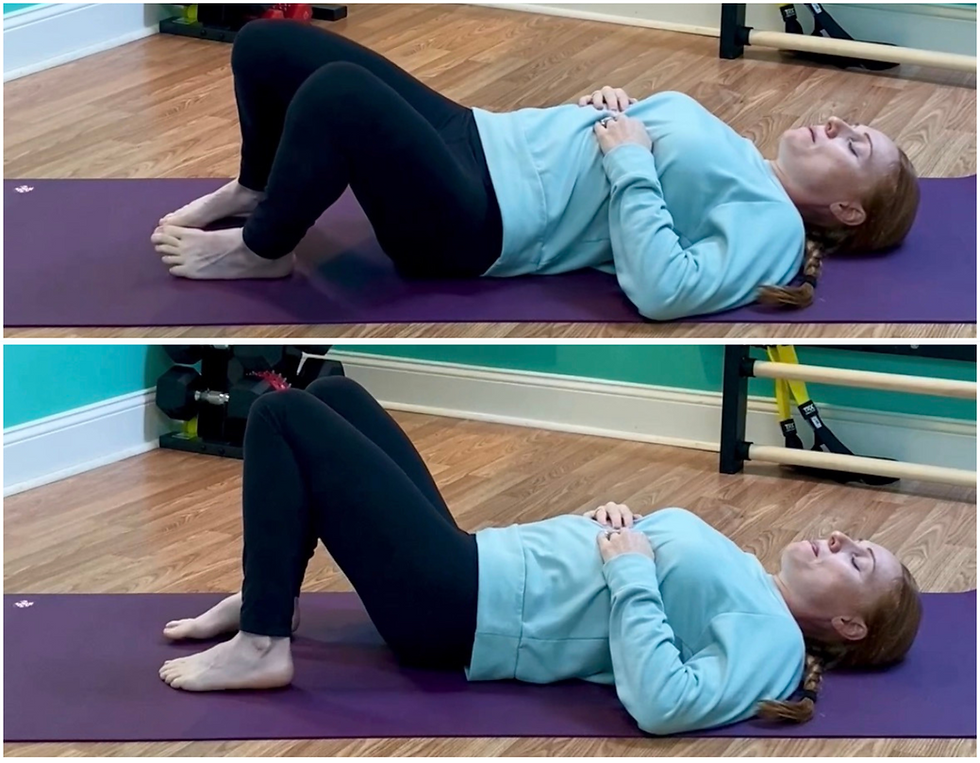
Pelvic Rocks: Start lying on your back with your knees bent, lying on a comfortable surface like your bed. Very slowly, with the smallest amplitude possible, rocking your pelvis forward and back trying to find an entry of no pain and no threat. Stay present in your body (is your back starting to tighten up) and your mind (are you having catastrophizing thoughts). As you rock a few rounds in this pain-free range, your body may want bigger movements, gradually increase as it feels tolerable.

Seated Rocking: Seated in a chair, feet flat on the floor: rock forward and back by just a centimeter or two. Let your weight shift through your sit bones. Keep it very small.
Stability Ball Rocking: On a yoga ball or wobble cushion: let gravity and the surface do most of the work. Just breathe and allow micro-movements.
Tabletop Rocking: On hands and knees: rock gently forward and back, keeping the range tiny at first. Notice where the movement feels smooth and where it stiffens -- don't push into the stiffness, just approach the edge and come back.

Rocking Chair or Hammock: In a rocking chair or a hammock: let the chair/hammock do the work entirely. Passive rocking counts.
Water Rocking: In water (if you have access): the buoyancy removes load from joints entirely, making gentle oscillation very accessible even on high-pain days.
Rocking Helps Your Brain Build a Better Map of Your Body
People with HSD and hEDS have proprioceptive deficits. Proprioception is your body's internal sense of where its parts are and how they're moving. In hypermobile connective tissue, the receptors that report this information are less reliable than in non-hypermobile bodies.
This has real consequences. Your brain plans every movement using its internal body map. When that map is patchy or inaccurate, movements become poorly coordinated, joints get loaded unevenly, and your muscles work overtime trying to compensate. It also means your body can feel strangely unfamiliar, blurry, or hard to inhabit, which many people with HSD/hEDS recognize.

Rocking addresses this directly. It generates a rich, continuous, multi-sensory stream of information: your vestibular system reports movement through space, your skin reports pressure shifting, your joints report position changes, your muscles report length changes. All of this feeds your brain data it can use to sharpen its map.
The key is the rhythmic predictability. Your brain can make a prediction ("if I rock left, I'll feel X"), receive the feedback, compare the two, and refine the map. Repetition by repetition, the map gets clearer. Movement becomes more coordinated. Your brain becomes more confident generating movement. A confident brain is a less pain-amplifying brain.
Takeaway: Rocking works better as a regular practice than as a one-off. Even a few minutes daily will accumulate. Think of it as maintenance for your brain's body map rather than a treatment you apply when things are bad (though it helps as a standalone rescue tool as well).
Why Rocking Reaches Stiffness That Stretching Doesn't
The chronic stiffness that comes with hypermobility is mostly neurological, not structural.
Because your joints are too mobile, your nervous system recruits constant sustained muscle contraction as a bracing strategy. It is trying to add the stability your passive structures aren't providing. This is protective in nature but can feel punishing in effect. Those muscles fatigue, generate waste products, compress joints, restrict circulation, and create the dense, exhausting stiffness many hypermobile people know well.
Stretching this stiffness aggressively tends to backfire, because the nervous system reads it as a threat to joint integrity and turns the guarding up rather than down.
Rocking bypasses this. The gentle oscillation pumps fluid through joints and surrounding tissue (synovial fluid, which lubricates your joints, moves through compression and release, not through blood supply). It increases local circulation. And crucially, it tells the nervous system, repeatedly and gently, that movement is happening and nothing bad is occurring. Over time, the chronic bracing can soften because you gave the system enough evidence of safety that it felt safe enough to rewire and let go of gripping patterns.
Takeaway: If you have an area of stubborn stiffness that doesn't respond to stretching, try rocking through a tiny range that passes near or around that area instead. Don't target the stiffness directly. Approach it with oscillation and patience.
A Simple Practice to Start With

If you want to bring rocking in as a regular tool, here's a simple structure:
Find a comfortable position: Seated, on a ball, on hands and knees, side lying, or lying on your back with knees bent. Whatever feels best.
Start with the smallest movement possible that still feels like movement. Give it 30 seconds to a minute. Notice whether it feels neutral, uncomfortable, or pleasant (in body and mind).
Increase range: If it feels neutral or pleasant, gradually increase the range very slightly. Keep checking in.
Stay with rocking for several minutes but don't rush progression of movement: Stay with any amplitude that feels good for several minutes. Don't rush to increase range. The nervous system learns through repetition more than through size.
Stay present: Notice what changes in your body as you continue: breath, thoughts, muscle tension, sense of warmth or ease in tissues. This is your body beginning to regulate its state.
Finish with a functional movement (if able): After rocking, try a gentle, functional movement: a slow walk, standing up from the chair, small squats. Often you'll find the movement quality is noticeably different.
Rocking works at so many levels simultaneously: regulating your nervous system, improving your brain's body map, reducing the chronic muscle guarding that causes secondary stiffness, and nourishing tissue that doesn't get enough fluid movement.
I love it because it asks almost nothing of a body that is often exhausted and in pain. And it offers something the nervous system genuinely recognizes, because it has known this particular kind of nourishment since before you were born.
Please keep in mind that the information presented are for education only. If you are interested in working with House of Balance, please book a free consultation.

Dr. Stephanie House has over 15 years of experience in the health and wellness field and currently owns her own practice as a mind-body physical therapist in Charlottesville, VA.
She holds post doctoral certifications in vestibular therapy, dry needling, yoga therapy, and pregnancy and postpartum. With extensive continued study on topics such as mind-body medicine, integrative health, breathwork, and somatic therapy, Dr. House's extensive knowledge and comprehensive approach gets to the root of movement dysfunction and pain.
If you are ready to change the way you move and feel, work directly with Dr. House or join the House of Balance Newsletter.
"I don't heal or fix people. What I do is get your body and mind to an optimal place so you can start to heal yourself. We all have a greater capacity to heal than we are led to believe. With the appropriate input and support, our bodies can do amazing things." Stephanie House, PT, Founder
For specific questions or inquiries, reach out to Dr. House directly: info@houseofbalancept.com or visit her website: www.houseofbalancept.com

Comments